
The Science Behind Ferrofluid and Magnetic Liquids
From NASA laboratories in 1963 to the living art on your desk — a complete guide to the extraordinary physics of ferrofluid, Rosensweig instability, and why magnetic liquids defy everything you thought you knew about matter.
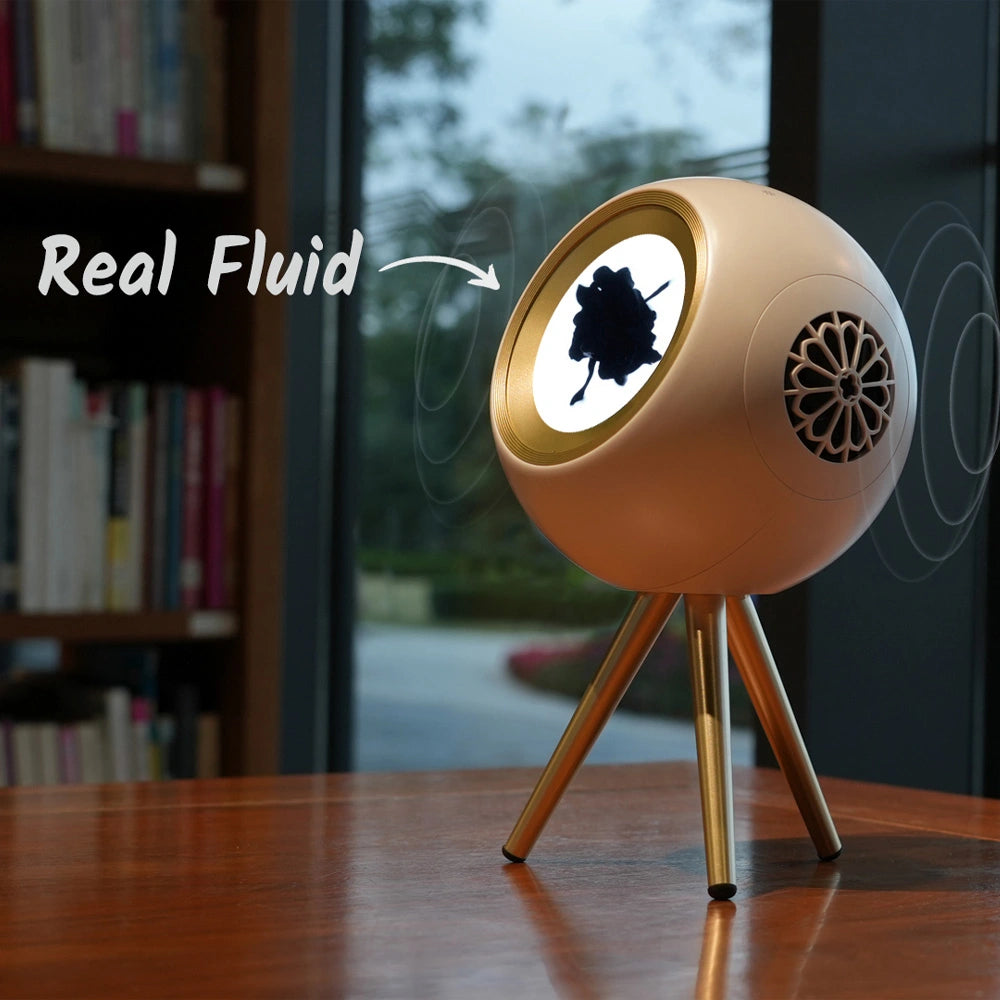
There are very few substances on Earth that can legitimately claim to belong in both a NASA rocket and on a living room desk. Ferrofluid — the black, magnetic liquid at the heart of the Glowbe Ferrofluid Speaker — is one of them. It is simultaneously a feat of nanotechnology, a physical anomaly, and one of the most visually captivating materials ever synthesized. This is the complete story of what ferrofluid is, why it behaves the way it does, and how that behavior became the most mesmerizing ferrofluid display technology available to consumers today.
What Is a Magnetic Liquid?
At first, the phrase "magnetic liquid" sounds like science fiction. Liquids, we're taught in school, don't respond strongly to magnetic fields. Magnetism is the domain of solids — iron, nickel, cobalt. Liquids flow and deform. They don't hold structure. So when a material manages to do both simultaneously — to be permanently, powerfully magnetic and to flow as freely as water — it occupies a genuinely extraordinary position in the materials science landscape.
This is exactly what a ferrofluid is. The term comes from ferrous (iron) and fluid (liquid). It is a stable colloidal suspension — meaning solid magnetic particles are permanently dispersed through a liquid medium without settling, clumping, or separating. In practice, a ferrofluid looks like a dense, dark liquid — almost oily — but the moment a magnet approaches, it springs to life in ways that contradict intuition.
A ferrofluid does not separate over time because each iron oxide nanoparticle is coated with a surfactant — a chemical layer that prevents the particles from clumping together. This coating creates electrostatic or steric repulsion between adjacent particles, maintaining permanent, stable suspension even under gravity and moderate magnetic fields.
Unlike ferromagnetic solids (which retain magnetization after the field is removed), ferrofluid is superparamagnetic. This means it becomes strongly magnetic only when a field is applied — and returns completely to a non-magnetic state the moment the field is removed. This unique combination of liquid behavior and on-demand magnetism is what makes ferrofluid so exceptional and so useful.
 ↑ Real ferrofluid in the Glowbe's hand-assembled glass dome responds in real time to magnetic fields.
The Physics of Ferromagnetism — Iron Oxide Nanoparticles
The secret to ferrofluid lies in scale. The iron oxide particles (typically magnetite, Fe₃O₄) used in ferrofluid are approximately 10 nanometres in diameter. For reference, a human hair is roughly 80,000–100,000 nanometres wide. These particles are so small they exist at the boundary between classical physics and quantum mechanics.
At this scale, each particle behaves as a single magnetic domain — a tiny permanent magnet containing just one region of aligned magnetic moment. Bulk iron contains billions of competing domains that cancel each other out at rest. At 10nm, there is only one domain per particle, and this domain can flip its orientation almost instantly in response to thermal fluctuations. This is the quantum origin of superparamagnetism.
The Carrier Fluid
Iron oxide nanoparticles alone would simply be a powder. The carrier fluid — typically a light hydrocarbon oil, kerosene, or water-based solution — provides the medium that allows the particles to behave as a collective, unified liquid. The carrier is chosen to match the target application: oil-based carriers suit industrial magnetics; water-based formulations are used in biomedical research; synthetic oil carriers are common in consumer products.
The Glowbe's proprietary Smart NanoFluid formula is hand-assembled in a sealed glass dome — a formulation designed specifically for visual performance: maximum contrast, optimal surface tension for defined spike formation, and long-term stability without degradation or settling.

Rosensweig Instability — Why Ferrofluid Forms Spikes
The most visually dramatic property of ferrofluid — the spiking, ridging, and geometric pattern formation that defines the dancing ferrofluid speaker experience — has a precise scientific name: the Rosensweig instability, named after physicist Ronald E. Rosensweig, who characterized it theoretically in the 1960s and 1970s.
Here's how it works. When ferrofluid sits flat on a surface with no magnetic field applied, surface tension dominates — the fluid maintains a smooth, even surface. The moment a magnetic field is applied perpendicular to the fluid surface, magnetic forces pull the fluid upward along the field lines. As the field strength increases, a critical threshold is reached: the magnetic pressure overcomes surface tension.
At this threshold, the smooth surface becomes unstable. The liquid cannot maintain a flat configuration — it's energetically favorable to form peaks. These peaks form not randomly but in precise, repeating geometric patterns determined by the wavelength of the instability (related to fluid density, surface tension, and magnetic permeability). The result is a regular array of conical spikes — one of the most striking and reproducible self-organizing structures in all of physics.
Why the Patterns Are So Mesmerizing
What makes the Rosensweig instability particularly compelling for display purposes is that the patterns are sensitive to small changes in field strength. A slight increase in magnetic force causes spikes to grow taller and sharpen. A slight decrease softens them into rolling waves. Oscillating fields produce fluid motion — ripples, pulses, flowing ridges. Every variation in the electromagnetic signal produces a unique, never-identical visual response. This is the foundation of the ferrofluid display experience in the Glowbe.

How Ferrofluid Was Invented — NASA 1963
Ferrofluid did not emerge from an art studio or a consumer electronics lab. It emerged from one of the most ambitious engineering projects in human history: the space race. In 1963, NASA engineer and scientist Stephen Papell filed a patent for a colloidal magnetic liquid — the first true ferrofluid — as a solution to a very specific and serious problem.
In zero gravity, liquids don't behave like they do on Earth. Rocket fuel floats freely in storage tanks, unable to be reliably directed to the engine by gravity alone. Papell's insight was to make the fuel itself magnetic — by suspending ferromagnetic particles in it — so that electromagnets could pull the fuel in any desired direction regardless of gravitational conditions. The result was a stable, controllable magnetic fluid: ferrofluid.
The first colloidal magnetic liquid is invented to solve rocket fuel control in zero-gravity environments during the Apollo era.
Ronald Rosensweig of Avco Corporation formalizes the theoretical framework for ferrohydrodynamics, explaining spike formation mathematically.
The audio industry discovers ferrofluid's thermal properties. It begins appearing inside speaker voice coil gaps as a heat dissipator, improving performance and longevity.
Ferrofluid becomes a standard engineering material in over 100 million speakers and headphones worldwide — almost entirely unknown to the consumers using those devices.
XELLO Technologies reimagines ferrofluid as the centrepiece of a consumer speaker, creating the world's most sophisticated personal dancing ferrofluid display.
From Lab Material to Consumer Product
Papell's original ferrofluid was crude by modern standards — the particles were relatively large and the formulation was optimized for fuel behavior rather than visual or acoustic performance. Over the following decades, materials scientists refined the synthesis process, producing progressively smaller and more uniform particles with increasingly stable surfactant coatings.
By the 1970s, audio engineers at companies including Ferrofluidics Corporation (now Ferrotec) had identified a compelling application: using ferrofluid inside the voice coil gap of a speaker driver. The magnetic fluid would naturally position itself in the gap due to the driver magnet, acting simultaneously as a thermal conductor (drawing heat away from the voice coil) and a mechanical damper (reducing unwanted resonance). This was a genuine engineering breakthrough — ferrofluid could increase a speaker's power handling by 10–20% while improving clarity at high frequencies.
Today, ferrofluid is used in hundreds of millions of speakers and headphones globally. It is one of the most widely deployed nanotechnologies in consumer electronics — yet almost no one knows it's there. The Glowbe by XELLO changes that entirely by bringing ferrofluid out of hiding and making it the visual and experiential centrepiece of a premium audio device. You can also explore other unique desk accessories that demonstrate technology at its most beautiful.
The Dancing Ferrofluid Speaker — Physics in Consumer Form
The Glowbe Ferrofluid Speaker transforms the abstract science described above into a real-time, interactive, audiovisual experience. Understanding the mechanism makes the experience even more impressive.
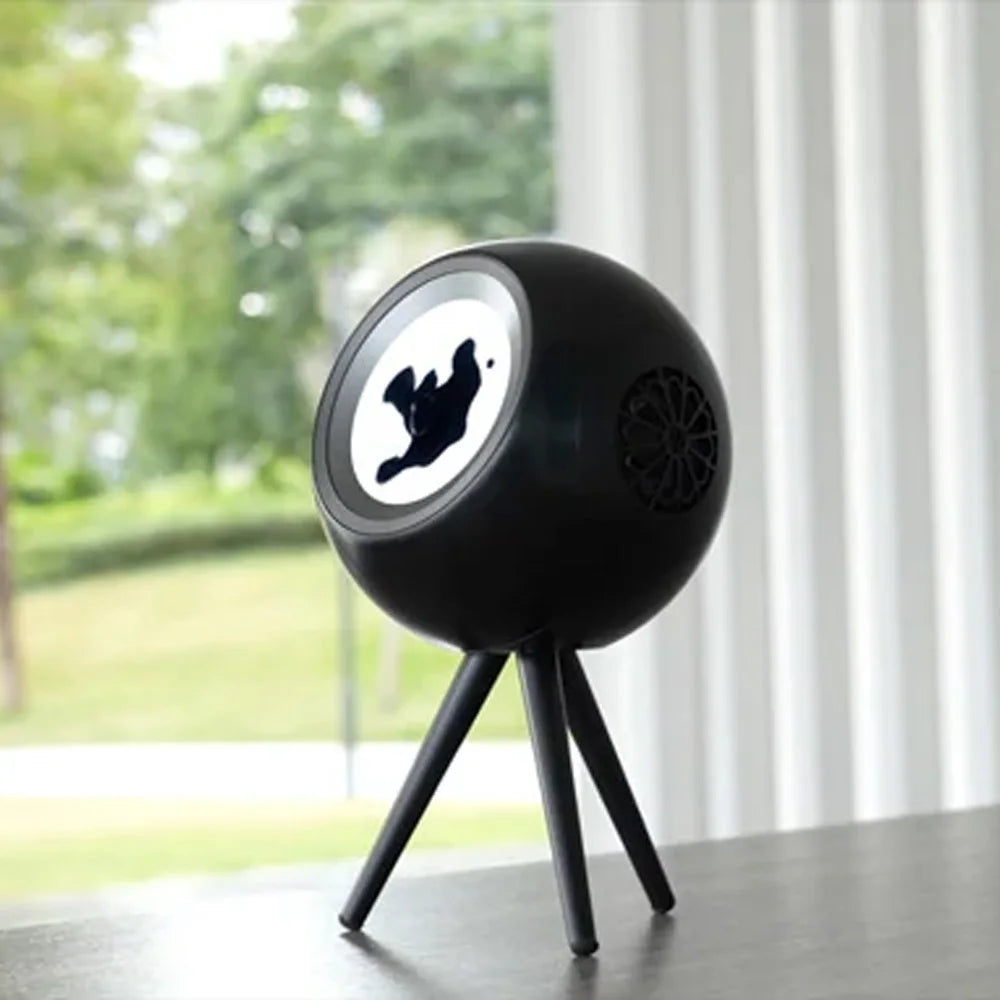
When you play music through the Glowbe, the built-in omnidirectional microphone captures the audio signal. A dedicated DSP (Digital Signal Processor) chip analyzes the frequency content in real time and converts it into precisely modulated electromagnetic pulses — with a latency of less than one millisecond. These pulses drive electromagnets positioned around the sealed glass dome containing the Smart NanoFluid ferrofluid formula.
The electromagnetic pulses vary in strength and frequency according to the music. Bass frequencies (65–250Hz) produce strong, bold pulses that create dramatic spike formations and sudden surface upheavals. Mid-range frequencies (250Hz–4kHz) produce flowing wave patterns and ripples across the fluid surface. High frequencies (4kHz–13.5kHz) create fine surface textures — subtle shimmering movements that add complexity to the visual output.
| Frequency Range | Audio Character | Ferrofluid Behavior |
|---|---|---|
| 65 – 250 Hz | Bass, kick drums, sub-bass | Bold spikes, dramatic formations, rapid surface upheaval |
| 250 Hz – 4 kHz | Vocals, instruments, rhythm | Flowing waves, ripples, organic pulse patterns |
| 4 kHz – 13.5 kHz | High-frequency detail, cymbal transients | Fine surface textures, shimmer, micro-movements |
The result: every song produces a completely unique, unrepeatable visual display. No two moments are identical. Because the patterns are governed by physics — not programming — there is no loop, no preset, no algorithm determining the output. The music itself writes the display, in real time, through the laws of electromagnetism and fluid dynamics. This is the fundamental difference between a ferrofluid display and any screen-based visualizer.
Frequently Asked Questions
Turn Music Into
Living Science
The Glowbe Ferrofluid Speaker by XELLO — 20W DSP-tuned audio, real ferrofluid display, Bluetooth 5.3. Ships free from California in 3–7 days.
Explore the Glowbe Ferrofluid Speaker → Browse Desk Accessories